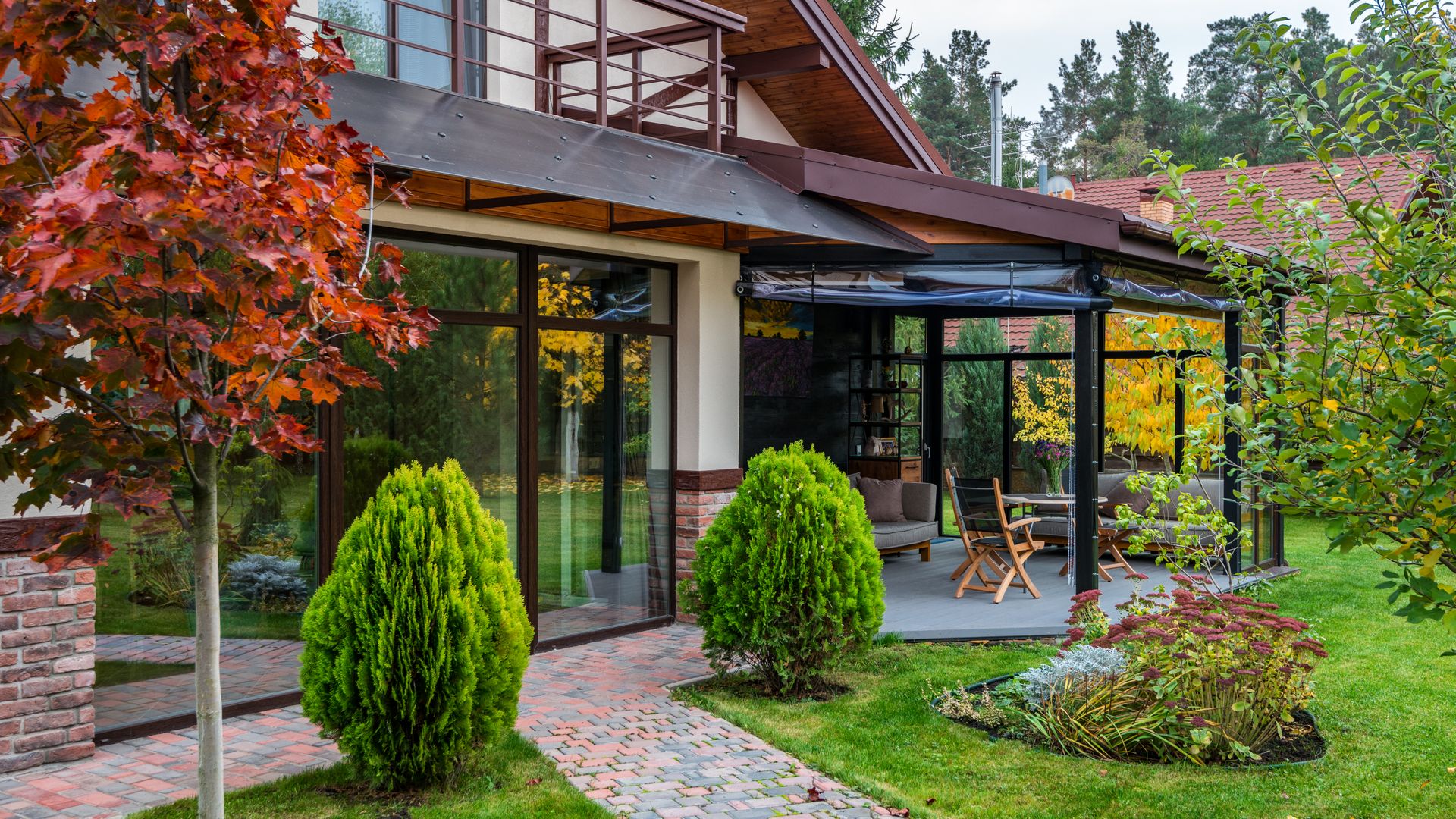
Cyprus · veranda enclosure
Veranda enclosure in Cyprus.Compare several quotes at once.
Enclosing a veranda is bought from a systems supplier rather than from a builder, and that changes what the transaction includes. The supplier measures, fabricates and installs. Whether the enclosure is permitted is generally nobody's task in that process, which is why so many are not.
- Registry-sourced data
- Field-level provenance
- Free removal on request
Veranda enclosure companies in Cyprus
A purchase, not a project
Most building work is bought as a service. A contractor comes, assesses, and carries out work on the property.
A veranda enclosure is bought as a product. A supplier measures the opening, quotes a system from a catalogue, takes a deposit, fabricates the frames in a workshop over several weeks and installs them in a day or two. The transaction resembles buying fitted windows more than it resembles engaging a builder.
That framing is accurate about what the supplier does and misleading about what the owner is doing to the building. Enclosing an open veranda converts outdoor space into covered floor area, and that is a change to the property that the planning system, the title documents and any future buyer will all treat as construction.
The gap between how it is sold and what it is accounts for most of the difficulties in this market.
What the sector consists of
Aluminium systems fabricators. The bulk of the market. They buy profile systems and glass, fabricate to measurements taken on site, and install. The skill is in fabrication and fitting; the system is a manufacturer's product they are approved to supply.
Glazing and curtain-glass specialists. Frameless and minimal-frame arrangements, sliding and folding systems, with a different product range and usually a higher specification.
Pergola, awning and shading firms. The lighter end — retractable roofs, louvred structures, shading that does not enclose. Frequently the better answer to the underlying problem, and a different conversation.
General builders. Solid enclosures with masonry walls, which is construction rather than a system purchase and is bought accordingly.
A client who approaches one of these has already chosen an answer. Approaching two of them — a systems supplier and a shading firm — produces quotations that are not comparable and a genuinely useful choice.
What the sales process does not include
The supplier's process is efficient because it is narrow. Four things sit outside it, and each is capable of causing more trouble than the enclosure is worth.
Consent. Whether the enclosure is permitted, given the plot's remaining allowance and the building's circumstances. The supplier is not appointed to establish this and generally does not.
Ownership of the elevation. In an apartment block, the facade and the external appearance of the building are usually not the individual owner's to alter. This is decided by the arrangements for that building, and a supplier measuring a balcony has no view on it.
Drainage and threshold detailing. An open veranda drains itself. An enclosed one has a threshold, a junction with the existing floor, and water that now has to be directed somewhere. Where the veranda's waterproofing was detailed as an external surface, enclosing it changes what that detail has to do.
Thermal behaviour. The glass specification, shading and ventilation that decide whether the resulting space is usable in July. A quotation priced on frames and panels does not answer this unless somebody asks it to.
None of these is the supplier withholding anything. They are simply outside a supply-and-fit contract, which means they are the owner's unless the owner moves them.
Where responsibility sits
This is worth stating plainly because it is where owners are most often surprised.
A supply-and-fit contract obliges the supplier to provide and install the system as specified. It does not oblige them to establish that the owner is entitled to have it, and their terms commonly say as much.
So if an enclosure is later found to be unauthorised, the position is the owner's to resolve. The supplier has performed. The structure stands on the owner's property, it appears in the owner's documents or fails to, and it is the owner who deals with the consequences at a sale, at a title transfer, or when a further permission is applied for.
The way to change that is to change the sequence, not the contract. Establish the permission position first — a modest piece of work for a professional registered with ETEK — and order the system afterwards. The framework governing what requires consent is set out in the reference on planning and building permits.
How enclosures are specified and priced
Quotations are built from the system rather than from the space, which is why two for the same veranda can differ substantially.
The profile system. Which manufacturer's range, and whether it includes thermal breaks. An unbroken aluminium frame conducts heat directly through itself, which matters on an elevation taking full sun.
The glass. Single or double, and what coating. Solar control glass costs more and does the work that decides whether the room is usable. Safety glass requirements apply in the positions where they apply.
The opening arrangement. How many panels open, and how — sliding, folding, lifting. This is where a large share of the cost sits, and it is a decision about how the space will actually be used rather than a specification detail.
Fixing to the structure. What the frames attach to, and whether that element can carry them. On a balcony with a slender edge beam or a non-structural parapet, this is a real question.
Making good. The threshold, the junctions, and any waterproofing detail disturbed by fixing into the structure.
A quotation stating only an area and a total has described the transaction and not the product.
Assessing a supplier
- Whether they raise the permission question, unprompted. Most do not, and one that does is telling a client something about how they work.
- The system they are approved to supply, and whether the approval is current.
- What the quotation specifies — profile, glass, opening arrangement, thermal break — as against a lump sum for an area.
- Installed work several years old, since the failures here are in operation: panels that stop running smoothly, seals that perish under ultraviolet, and water finding the threshold.
- Who handles the threshold detail, which is where the enclosure meets building work and where the two trades most often each assume the other.
- The guarantee, separated into the system and the installation.
What happens after installation day
The supplier leaves once the frames are in, and everything from that point is the owner's to live with. Three things are worth knowing before the deposit rather than after.
Operation is the failure mode. Enclosures rarely fall down. What they do is stop working smoothly — rollers wear, tracks collect the dust that a Cypriot summer delivers continuously, and panels that slid easily in the first year need force in the fourth. Cleaning the tracks is genuinely maintenance rather than housekeeping, and a system whose rollers can be replaced without dismantling the frame is worth more over its life than one whose cannot.
Seals and gaskets are consumables. Ultraviolet exposure degrades them, and they are the part that keeps out the wind and rain the enclosure was bought to exclude. Whether the supplier stocks replacements for that system, years later, is a fair question to ask while they still want the order.
The system has to remain available. A panel broken by a storm or an accident is replaced from the same range, and a supplier who has changed suppliers or ceased trading leaves an owner with a matching problem rather than a repair. Buying a widely used system from an established fabricator is worth something specific here, and it is not about the quality of the aluminium.
Recurring mistakes
The system is ordered before anybody establishes whether the enclosure is permitted, and the fabrication deposit is spent by the time the question is asked. In an apartment, a balcony is enclosed without establishing whether the elevation is the owner's to change. Glass is specified on price, and the resulting space is unusable through the summer it was built for. Ventilation is not considered, so the enclosure that solved a wind problem creates a condensation one in winter. The threshold is left to whichever trade arrives second. And the enclosure is never reflected in the property's documents, which converts an improvement into a discrepancy at the point of sale.
The alternative worth pricing alongside
Owners enclose verandas for identifiable reasons: wind, dust, insects, rain during a few winter weeks, or a wish for more usable floor area.
Only the last of those requires an enclosure. The others are addressed by shading, screens, glazed panels that retract, and louvred roof systems — none of which converts outdoor space into covered floor area, and none of which therefore engages the same permission questions or produces the same summer heat problem.
That makes a quotation from a shading firm a genuinely useful second document to hold, even for an owner who intends to enclose. It prices the underlying problem rather than the chosen solution, and it occasionally reveals that the problem was smaller than the answer being bought for it.
Where more floor area really is the objective, the enclosure is the right category — and it should then be treated as what it is, which is a small construction project with a supplier attached rather than a purchase with a building consequence.
Common questions
- Who supplies veranda enclosures in Cyprus?
- Predominantly aluminium systems fabricators, who buy profiles and glass, make up the frames in a workshop and install them. Pergola and awning firms cover the lighter end, and general builders handle solid enclosures with masonry walls. They are different businesses with different capabilities.
- Does enclosing a veranda need permission?
- Enclosing an open space generally converts it into covered floor area, which engages the planning system. Whether consent is available depends on the plot's remaining allowance and the building's position, and in an apartment block on the arrangements for that building. It should be established before anything is ordered.
- Is the supplier responsible for obtaining consent?
- Almost never, and their documents usually say so or say nothing. A quotation for a system is a quotation to supply and fit it, and the permission position is the owner's responsibility unless the contract explicitly states otherwise.
- How long does an enclosure take to supply?
- The installation is short — frequently a single day — and the fabrication lead time before it is the real duration. That contrast is part of why the work reads as a purchase rather than as construction, and part of why the preliminary questions get skipped.
- What determines the price of an enclosure?
- The system and profile, the glass specification, how many panels open and how, whether thermal breaks are included, and the difficulty of fixing to the existing structure. Glass and opening arrangements move a quotation more than the overall area does.
- Will an enclosed veranda be usable in summer?
- Not without shading, ventilation and appropriate glass. A glazed space on a Cypriot elevation collects solar gain all day, and the enclosure alone converts a usable shaded veranda into a room that has to be cooled to be entered.
01Before you shortlist
Reading a veranda enclosure listingthe way it was written.
Each profile records what could be verified and where every detail came from. These four checks use that record properly.
Check the source of each field
Every detail on a profile names its source and retrieval date. A claim without a register behind it is presented as exactly that.
Provenance
Compare within the category
Categories group businesses doing comparable work, so registrations and coverage mean the same thing across a page.
Like for like
Narrow by district
Coverage is recorded town by town. A firm listed in Paphos rarely quotes in Famagusta without pricing the distance in.
5 districts
Contact the business directly
Profiles link the company’s own channels. The directory takes no commission and adds no intermediary.
No commission

Need veranda enclosure?One form. Up to five quotes.
Tell us what you need and we will gather quotes from qualified companies where you live.