Cyprus · insulation
Insulation in Cyprus.Compare several quotes at once.
There is no single insulation trade in Cyprus. The work is carried out by renderers, roofers, drylining firms and specialist applicators depending on where it goes, and a client looking for one contractor is usually looking for the wrong thing. This page sets out how the market is divided.
- Registry-sourced data
- Field-level provenance
- Free removal on request
Insulation companies in Cyprus
- #2PromotedWaterproofed Cyprus
Waterproofing, roofing and damp work across Cyprus, with the membrane system named in the quote.
No such trade, and what that means
A client searching for an insulation contractor in Cyprus is searching for a category that does not exist as a business.
What exists is a set of trades that install insulation as part of what they already do. A rendering contractor fixes boards to an external wall and renders over them, because the rendering is the part requiring their skill. A roofer lays insulation under a new covering, because the covering is the job. A drylining firm builds an insulated lining inside a room. A specialist applicator sprays or injects a product with equipment nobody else owns.
The consequence for a client is that the surface decides the contractor, not the material. Deciding to insulate is not enough to know who to call, and receiving quotations from firms working on different surfaces produces a set of documents that cannot be compared with each other at all.
The first decision is therefore which element is being treated — roof, external wall, internal wall, floor — because that decision selects the trade.
What drives the market
Two forces, and they act on different parts of it.
Regulation on new construction. New buildings and major renovations are subject to energy performance requirements, and an energy performance certificate is required when a property is sold or let. These requirements are expressed as the performance of the building rather than as a list of products, which means insulation appears in a new build as one of several means of meeting a target set by a designer.
Cooling cost on existing stock. Most Cypriot housing predates any meaningful performance requirement, and the reason owners insulate it is the electricity that air conditioning consumes through a long summer. This is the retrofit market, it is much larger than the new-build one, and it is driven by running cost rather than by compliance.
The distinction matters when reading a contractor's experience. A firm whose work is new construction is working to a designer's specification within a permitted project. A firm working on retrofit is making judgements about an existing building, and those are different competences.
Where insulation goes in a Cypriot building
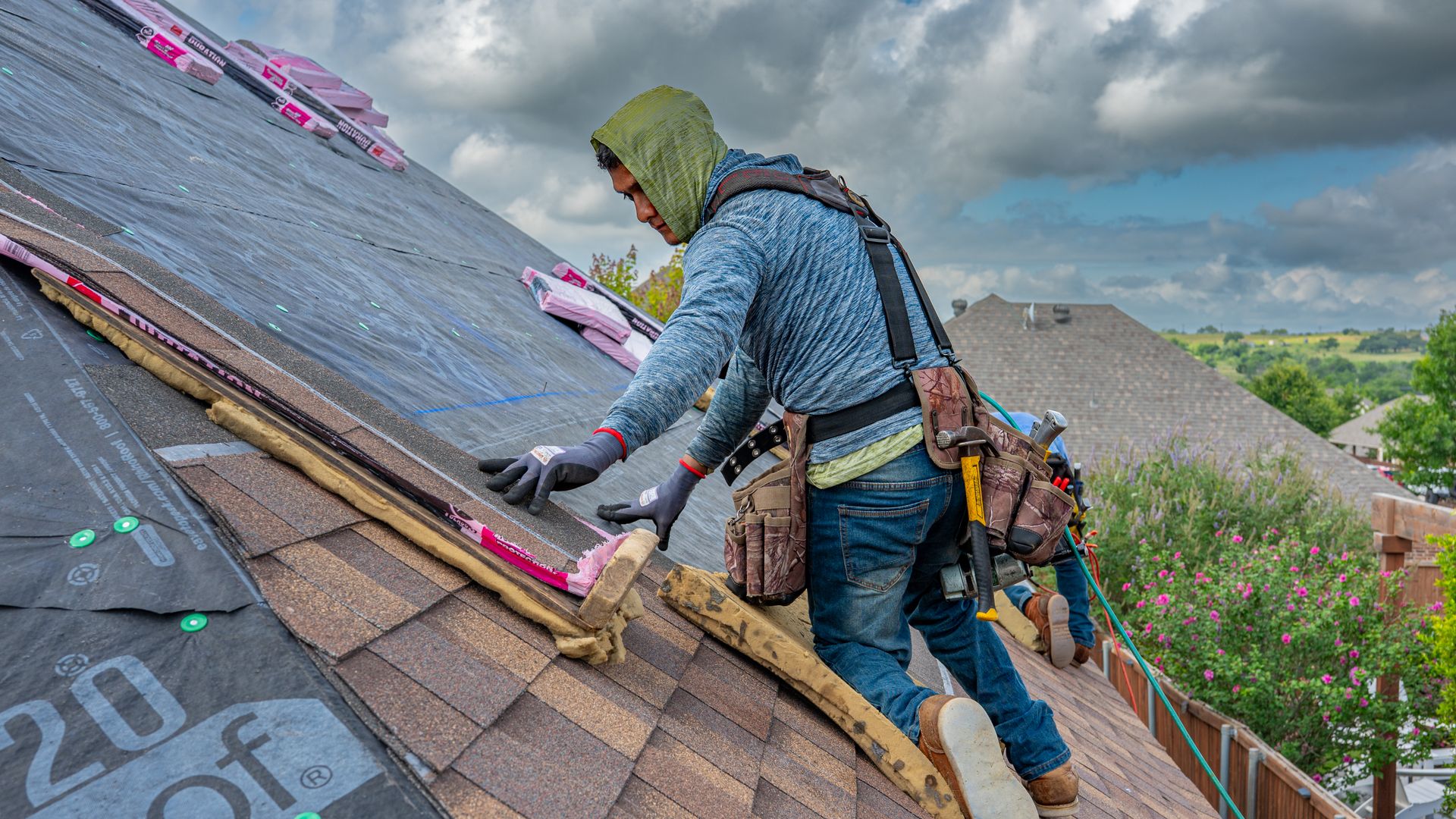
The roof. On the island's flat concrete construction this is the surface taking the most radiation, and it is the element where treatment usually returns the most. Insulation may go above the slab beneath a new waterproofing layer, or below it as a ceiling treatment inside the room. The first shares access and strip-out with roofing work; the second is a self-contained job with its own making good.
External walls. A system fixed to the outside of the building, rendered over. It covers the concrete frame along with the block infill, which matters because the frame is where heat moves through most readily in this construction. It requires access, it changes the elevation, and on an apartment block it requires the agreement of everybody who owns part of that elevation.
Internal walls. A lining built inside the room. No access, no agreement, no change to the appearance — and the room becomes smaller, everything fixed to the wall has to come off and go back, and the frame remains untreated.
Floors and soffits. Less common, and worth considering mainly where a room sits above an unheated space such as an undercroft or a garage.
Openings. Not insulation as such, but glazing and shading act on the same load, and on a Cypriot elevation shading a window frequently does more than insulating the wall around it.
How the work is bought
Because the contractor is selected by surface, the procurement follows the element rather than the material.
Where a roof covering is being renewed, insulation belongs in that contract as an addition, and pricing it separately later means paying twice for the same access. Where an external wall system is being installed, it is a rendering contract with a specification attached. Where an internal lining is being built, it sits within the drylining or the general refurbishment package.
Quotations are normally per square metre of treated area, with the details — reveals, terminations, junctions — measured separately or absorbed. The two items most often outside the figure are access and making good, and both are substantial: scaffold on external work with a hire duration, and on internal work the skirtings, architraves, electrical accessories and redecoration that follow a lining being built.
Where a manufacturer's system warranty is part of what is being bought, it generally requires the contractor to hold current approval from that manufacturer, which is a question to ask before comparing totals rather than after signing.
The levels below come from published sources rather than from quotations gathered here, and they describe a general band. Which element is being treated, and by which trade, is what places a job within it.
| Work | Indicative range | Midpoint | Published sources |
|---|---|---|---|
| InsulationThermal insulation of the roof of an existing Cyprus dwelling, materials and labour, specified to bring the average roof U-value to no more than 0.40 W/m2K as the state grant requires. Price depends on roof area, insulation material and method, and on whether the parapet also has to be insulated. The RES and Energy Saving Fund grant covers 50 percent of eligible cost capped at EUR 2,500 or EUR 25/m2, whichever is lower, rising to 75 percent and EUR 37.50/m2 for vulnerable households and by a further 50 percent in mountainous areas. Screed and a waterproofing layer on top are additional. | €25–€40per m² | €30 |
|
Indicative range compiled from published sources, not a quote. It shows the level those sources report for this kind of work, not what your job costs. Only a site visit and a written quote for your actual scope produce a real figure. Sources compiled 2026-08-02.
Assessing a contractor
- The right trade for the surface. A rendering firm for an external system, a roofer for a roof, a drylining firm for an internal lining. Competence in one does not transfer.
- Whether they work to a specification or supply a product. A firm that states the full build-up layer by layer is offering a specification.
- Manufacturer approval, where a system warranty is in play.
- Completed work that has been standing a few years, since the failures in this work are slow ones — cracking at junctions, staining, movement in a finish.
- What they say about the junctions. Reveals, the base of a wall, the roof edge and any point where the insulation stops are where performance is lost and where water gets behind a system.
- Making good, named explicitly, with responsibility allocated.
Recurring mistakes
Quotations are gathered from firms working on different elements and compared on price. Insulation is commissioned separately from a roof covering that is being replaced anyway, so the access is paid for twice. The reveals around openings are left untreated, which leaves a direct path around the insulation on a construction where reveals are deep. An internal lining is built without anybody considering where moisture will end up. Ventilation is reduced along with heat loss, and a property that was draughty and dry becomes sealed and damp. And on an apartment block, an external system is planned before establishing whether the elevation is one owner's to alter — which it usually is not.
Ventilation is part of the same decision
Insulating a building changes how it handles moisture, and that is a single decision rather than two.
Cypriot construction has historically been leaky enough that moisture generated inside — cooking, washing, drying, breathing — left the building without anybody arranging it. Reducing heat transfer generally reduces air movement as well, and moisture that previously left now condenses on the coldest surface available.
That surface is frequently an untreated cold bridge: a reveal, a lintel, or a section of frame the insulation did not cover. The mark that appears there looks like a damp problem and is a design consequence.
A contractor who raises ventilation while quoting insulation has understood the building as a system. It is a reliable signal, and it costs nothing to ask.
What the certificate does and does not tell a buyer
An energy performance certificate accompanies a property being sold or let, and it is the one piece of documented energy information most owners encounter.
It is worth understanding what kind of document it is. The rating describes the building as assessed against a standard method, not the electricity a particular household will use — occupancy, how many rooms are cooled, and what temperature they are held at move actual consumption far more than the rating band does. Two identical apartments with the same certificate can produce very different bills.
What the certificate is useful for is comparison between properties and, more practically, the recommendations attached to it. Those identify which elements of the building are performing worst, which is the information a retrofit decision needs and which an owner would otherwise be guessing at.
For a contractor's purposes, a certificate and its recommendations are a starting scope rather than a specification. They indicate where attention is warranted; they do not state a build-up, and a firm quoting directly from a certificate without inspecting the building has skipped a step.
Regional variation
Coastal properties in Limassol, Larnaca, Paphos and the Famagusta area combine high cooling load with salt exposure, which acts on the fixings and the finish of an external system rather than on the insulation itself, and pushes the specification toward corrosion-resistant components.
Inland, Nicosia and the central plain reach the highest summer temperatures on the island, and cooling load dominates the calculation almost entirely. Roof treatment and shading are where the attention goes.
In the Troodos, the balance shifts: winter heating is a real load at altitude, freeze-thaw becomes a consideration for external finishes, and the properties are frequently older traditional construction where a modern impermeable system is the wrong answer for reasons that have nothing to do with thermal performance.
Across all three, the housing stock is dominated by buildings put up before performance requirements existed, which is why retrofit rather than new construction is where this market sits.
Common questions
- Who installs insulation in Cyprus?
- It depends where it goes. External wall systems are installed by rendering contractors, roof insulation by roofing firms as part of a covering, internal wall and ceiling insulation by drylining trades, and sprayed or injected products by specialist applicators. Each is a different business with different equipment.
- Is insulation required by regulation in Cyprus?
- New buildings and major renovations are subject to energy performance requirements, and an energy performance certificate is required when a property is sold or let. The requirements apply to the building as a whole rather than mandating a particular product, so insulation is one of the means of meeting them rather than a separate obligation.
- Does insulation help in a hot climate?
- Yes, in the same way and for the same reason. Insulation slows heat transfer in whichever direction it is going, so it reduces cooling load in summer as it reduces heating load in winter. Cypriot properties run air conditioning for a substantial part of the year, and that is the load insulation acts on.
- Should insulation go inside or outside the wall?
- Externally where it is possible, because it covers the concrete frame as well as the block infill and leaves rooms their dimensions. Internally where external work is not available — on an apartment, where elevations are controlled, or where collective agreement cannot be obtained.
- Is roof or wall insulation the higher priority?
- On most Cypriot properties the roof, because a flat roof takes the full day's radiation on a horizontal surface and because the work can usually share access with a covering that is being renewed anyway. That sharing changes the economics more than any comparison of the two surfaces does.
- Can insulation be added to an existing property?
- Yes, and most of the work in this market is retrofit. What varies is disruption: external systems need access and change the appearance, internal ones need rooms emptied and everything on the wall removed and refitted, and roof work is usually tied to the covering.
01Before you shortlist
Reading a insulation listingthe way it was written.
Each profile records what could be verified and where every detail came from. These four checks use that record properly.
Check the source of each field
Every detail on a profile names its source and retrieval date. A claim without a register behind it is presented as exactly that.
Provenance
Compare within the category
Categories group businesses doing comparable work, so registrations and coverage mean the same thing across a page.
Like for like
Narrow by district
Coverage is recorded town by town. A firm listed in Paphos rarely quotes in Famagusta without pricing the distance in.
5 districts
Contact the business directly
Profiles link the company’s own channels. The directory takes no commission and adds no intermediary.
No commission

Need insulation?One form. Up to five quotes.
Tell us what you need and we will gather quotes from qualified companies where you live.