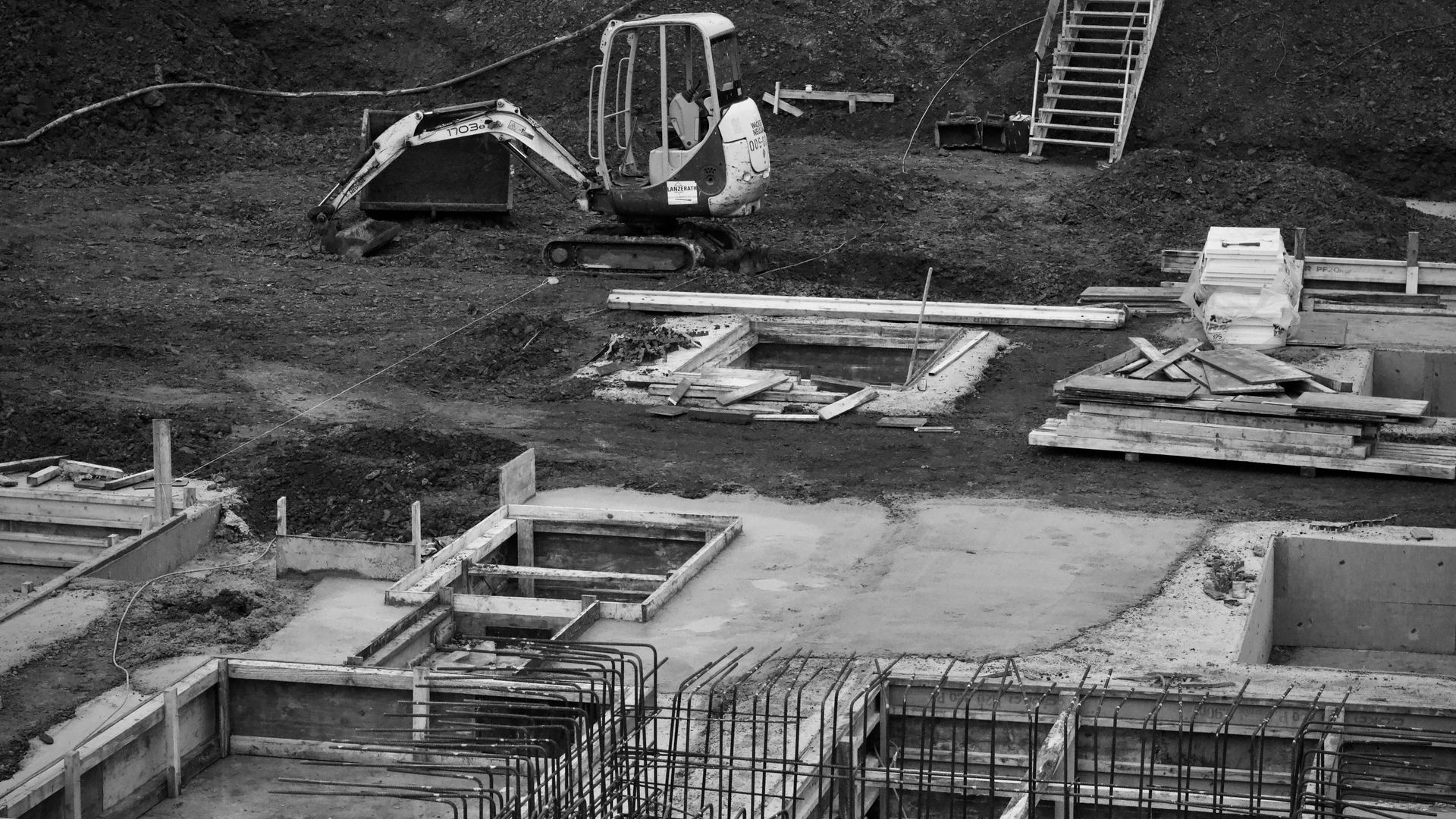
Cyprus · groundworks
Groundworks in Cyprus.Compare several quotes at once.
Groundworks is the first trade on a Cypriot site and the one whose scope is least consistently defined. This page sets out what the package normally contains, how contractors in this trade are structured, how the work is bought and priced, and where it hands over to everybody else.
- Registry-sourced data
- Field-level provenance
- Free removal on request
Groundworks companies in Cyprus
The first trade, and the least defined
Groundworks precedes everything. Nothing else on a Cypriot site can start until the ground has been cleared, dug, supported where it needs support, drained, and topped with a slab that the frame will stand on.
It is also the trade whose scope boundary is drawn most inconsistently. Two contractors quoting "groundworks" for the same house can be describing packages that differ by a substantial share of the work — one finishing at the slab, the other including the driveway, the boundary wall and every external drain.
That inconsistency is not evasion. There is no settled convention, and the sensible response is to write the boundary into the enquiry rather than to discover it afterwards.
What the package normally contains
Site clearance. Removing vegetation, obstructions and any remains of previous structures, and establishing a working surface and an access route for plant.
Excavation. Digging to formation level for foundations, and any bulk excavation where levels are being changed. The excavated material becomes either fill used on site or spoil going off it, and which of those it becomes is one of the largest single variables in the price.
Retaining structures. On a sloping plot, whatever holds the ground back — designed by an engineer, built by this contractor, and frequently a larger element of the cost than the foundations themselves.
Foundations. Pads, strips, rafts or piles as designed. On the island's reinforced concrete construction, this is the reinforcement and concrete that the frame springs from.
Below-slab drainage and services. Foul and surface water drainage, ducts for electricity, water and telecoms, and anything else that has to be in the ground before the slab is cast. Once concrete is poured, adding a route means breaking it out.
Hardcore, membranes and the slab. The build-up beneath the ground floor, compacted in layers, and the slab itself.
External works. Driveways, paving, steps, boundary walls, and the drainage serving them. This is the element most often assumed to be inside a package and found to be outside it.
How the trade is organised
Groundworks contractors are defined by plant more than by labour. An excavator, a dumper and the transport to move them are the fixed assets of the business, and much of what distinguishes one firm from another is the fleet they own against the fleet they hire.
That has two consequences worth knowing.
The first is that mobilisation is a real cost. Getting plant to site — and off it again — is charged whether the machine works for a week or a day, which is why small groundworks jobs carry a proportionally higher price than large ones and why a contractor already working nearby can offer a better one.
The second is that the trade overlaps with demolition at one end and with external landscaping at the other. Many Cypriot firms carry out all three, because the plant and the disposal arrangements are the same. A firm's actual centre of gravity is worth asking about, since a business built on plot clearance and one built on engineered foundations are differently equipped for a technical job.
Some firms also carry the concrete and reinforcement work up through the frame, which is a different structure of contract again, and it removes an interface that otherwise has to be managed.
Who else is involved
- An engineer registered with ETEK designs the foundations and any retaining structure, and supervises where the permit requires it. This is not the contractor's decision to make.
- A surveyor or the engineer sets out the building position and the levels the whole project will be built from.
- Testing of ground conditions and, on some projects, of compaction and of the concrete itself.
- A licensed carrier and receiving facility for material leaving site.
- The utilities, whose requirements determine where ducts and connections have to be and at what depth.
Lead times on the design and the setting out sit ahead of the contractor arriving, and a programme that starts with the excavator has skipped them.
How the work is bought and priced
The normal basis is measured quantity. Excavation by volume, concrete by volume, reinforcement by weight, drainage by length, and the slab by area, with plant and its transport priced as their own items.
Three things sit alongside those quantities and account for most of the variation between quotations.
Disposal. Whether excavated material stays on site as fill or leaves it as waste. Removing it means transport and a charge at a licensed facility by volume, and on a plot with no room to store material there is no alternative.
Rock. Excavation through rock is a different operation from excavation through soil, and many quotations are priced on the assumption of not meeting it. A stated rate for rock excavation, agreed before work starts, converts the most common dispute in this trade into an arithmetic exercise.
Water. Ground water, or water arriving from elsewhere on a sloping site, turns an open excavation into a pumping operation with a duration. Whether that is inside the price should be explicit.
Where quantities genuinely cannot be established in advance, part of the work may be let on a rate basis rather than a lump sum. That is a legitimate arrangement and a different one commercially: the client carries the quantity risk, so it needs measurement records and a mechanism for agreeing them as the work proceeds.
The levels below are compiled from published sources rather than from quotations gathered here, and they describe a general band rather than a plot. Scope boundary and ground conditions are what place a specific job within it.
The interfaces
Groundworks hands over to several trades, and the handover points are where self-managed projects most often lose time.
To the frame contractor, at the slab or at the foundation, with levels and starter bars where the design says they should be.
To the drainage and plumbing trades, at the connection points left in the ground, which have to match what the internal design assumes.
To the electrical contractor, at the ducts and at the earthing arrangement, which is set in the ground and is difficult to revisit.
To external works, if those sit in a separate package — in which case somebody has to own the level at which one stops and the other starts.
Each of these is a question about who is responsible for what, answered before the concrete rather than after. On a project with a main contractor, that coordination is what the main contractor is being paid for. On a self-managed build, it is the client's job, and it is the part most often underestimated.
Assessing a contractor
- Comparable projects, specifically on ground resembling the plot — a firm whose work is flat urban sites is differently experienced from one working on Troodos slopes.
- Plant owned against hired, which affects both availability and the mobilisation cost.
- Insurance, including cover for damage to neighbouring property and to buried services.
- How they price the unknowns — rock, water, unsuitable material — and whether those rates are in the quotation or left open.
- Disposal arrangements, with the carrier and facility named.
- Whether they work to an engineer's design routinely, which is a different habit from working to their own judgement.
Recurring mistakes
The scope boundary is never written down, so two quotations for different packages are compared on their totals. Disposal is assumed rather than priced, and the first loads leaving site become a variation. No rate for rock is agreed, and the conversation happens with plant standing idle. Setting out is treated as the contractor's problem rather than the engineer's, and an error at this stage is carried up through every floor above. Service ducts are omitted because nobody had finalised the internal layout, and the slab is broken out later. And on a sloping plot, the retaining structure is treated as a detail when it is frequently the largest single item in the package.
What the island's conditions add
Cypriot ground varies over short distances, and a neighbour's experience is weak evidence for a given plot. Rock near the surface, expansive clays that move with moisture, and made ground on previously developed land all occur, and each changes the foundation design rather than merely the digging.
Slopes are common, particularly in the foothills and on coastal land developed up from the sea, and a sloping plot converts groundworks from a preliminary into a major package with retaining structures, level changes and access constraints of its own.
Rainfall arrives concentrated, which matters to an open excavation more than to any other stage of a build. A hole in the ground during a storm becomes a pumping problem, a stability problem and a programme problem at once, which is why the season a groundworks package is programmed into is a commercial decision as well as a practical one.
Common questions
- What does a groundworks package include?
- Typically site clearance, excavation, any retaining structures, the foundations, drainage and service routes below the slab, hardcore and the ground floor slab itself. External works — driveways, paving, boundary walls — may sit in the same package or in a separate one, and which is the case should be settled before quotations are compared.
- Are groundworks contractors licensed in Cyprus?
- Not as a trade. The design of foundations and retaining structures is the responsibility of an engineer registered with ETEK, and the work is carried out under a building permit where one applies, so the oversight arrives through the design and supervision route rather than through a contractor licence.
- Is groundworks bought separately or within a main contract?
- Both arrangements are common. On a project with a main contractor it is normally a subcontract package. On a self-managed build it is frequently the first trade contract the client signs directly, which makes the client responsible for the interfaces the main contractor would otherwise manage.
- How is groundworks priced?
- Mostly by measured quantity — excavation by volume, concrete by volume, drainage by length, slab by area — with plant and its transport to site as separate items. Where quantities are genuinely unknown, parts of the work may be priced on a rate basis instead, which is a different kind of contract.
- Why do groundworks quotations vary so much?
- Because the scope boundary varies. Whether disposal of excavated material is included, whether the price assumes rock is not encountered, whether service ducts and external drainage are inside the package, and where the work stops all shift the total substantially without any rate changing.
- What is the most common cause of a variation?
- Material that has to be removed from site. Excavated spoil is bulky, its quantity is only estimated until digging starts, and disposal is charged by volume at a licensed facility. A quotation that assumes spoil stays on site and a site where it cannot are a variation waiting to happen.
01Before you shortlist
Reading a groundworks listingthe way it was written.
Each profile records what could be verified and where every detail came from. These four checks use that record properly.
Check the source of each field
Every detail on a profile names its source and retrieval date. A claim without a register behind it is presented as exactly that.
Provenance
Compare within the category
Categories group businesses doing comparable work, so registrations and coverage mean the same thing across a page.
Like for like
Narrow by district
Coverage is recorded town by town. A firm listed in Paphos rarely quotes in Famagusta without pricing the distance in.
5 districts
Contact the business directly
Profiles link the company’s own channels. The directory takes no commission and adds no intermediary.
No commission

Need groundworks?One form. Up to five quotes.
Tell us what you need and we will gather quotes from qualified companies where you live.