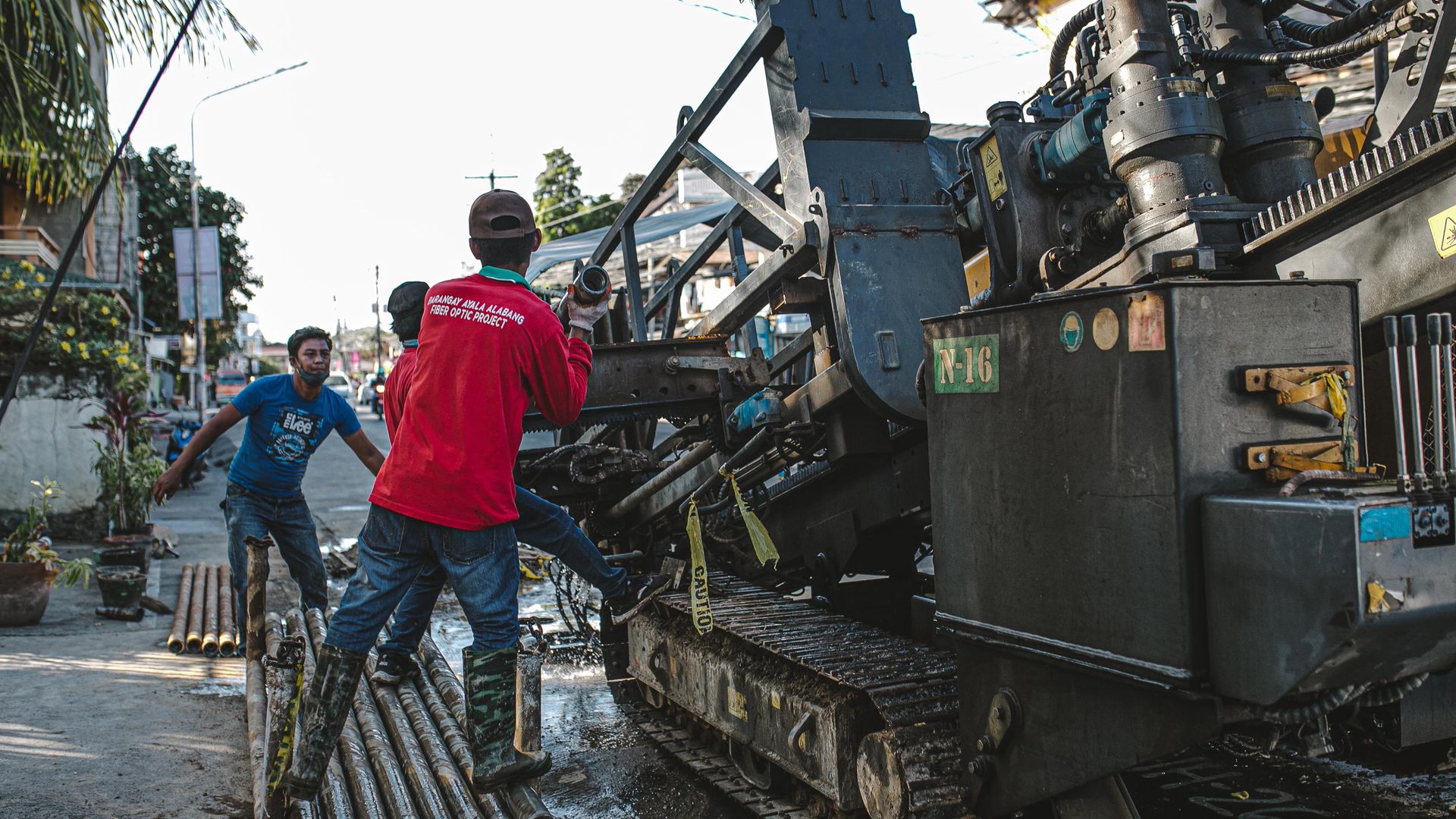
Cyprus · borehole drilling
Borehole drilling in Cyprus.Compare several quotes at once.
A borehole is a piece of infrastructure attached to land, with components that wear at different rates and several trades involved across its life. This page describes what it consists of, who maintains it, and what an existing one on a Cypriot property should be checked for.
- Registry-sourced data
- Field-level provenance
- Free removal on request
Borehole drilling companies in Cyprus
Infrastructure, not an installation
Most things bought for a property are installed and then used. A borehole is different: it is a piece of infrastructure that interacts with a natural system, and it changes over time for reasons that have nothing to do with how it was built.
The aquifer it draws from rises and falls seasonally and across years. The screen through which water enters gradually clogs. The pump wears. Neighbouring abstraction changes what is available. A borehole that performed well in its first summer may perform differently in its tenth, and none of that implies anything went wrong.
Understanding it as infrastructure rather than as a purchase changes what an owner does with it: it gets measured periodically, it has a maintenance history, and its documents matter as much as its hardware.
What the asset consists of
The hole. Drilled to a depth determined by where water was found, through whatever formations lie beneath the site.
Casing. The lining that keeps the hole open and prevents material collapsing into it. Diameter and material are specification decisions, and the diameter constrains what pump can ever be fitted.
Screen. The section, set against the water-bearing formation, through which water enters. Its slot size is matched to the surrounding material, and it is the component that clogs.
Gravel pack. Graded material placed around the screen to filter the formation and keep fine material out. Where it is absent or wrongly graded, the borehole pumps sand, which wears everything downstream of it.
Surface seal. A grouted section near the top preventing surface water — and whatever it carries — running straight down the outside of the casing into the aquifer. This is a contamination protection rather than a performance one.
Pump, rising main and cable. A submersible unit set at a depth chosen for the water level and the yield, with the pipe and cable serving it.
Controls and protection. Starting equipment, and protection against running the pump dry, which is the most common way a pump is destroyed.
Storage and delivery. A tank, pressure equipment, and whatever distributes the water to its use.
The components have very different lives. The hole and casing may serve for decades; the pump is a machine with a service life measured in years.
Which trades are involved
Drilling contractors own rigs, and their work is the hole, the casing, the screen and the initial development. They are mobilised, they drill, and they leave.
Pump and water systems firms select, install, service and replace the submersible pump, the rising main, the controls and the storage. This is electrical and mechanical work, and it is where most of a borehole's lifetime service events sit.
Electrical contractors deal with the supply to the installation, which is a licensed activity in Cyprus and where certification requirements apply.
Water testing laboratories analyse quality against the standard relevant to the intended use.
Hydrogeologists interpret what the hole is doing — falling levels, declining yield, changing quality — and advise on whether the answer is equipment, rehabilitation, or a reduced expectation.
A property owner who thinks of "the borehole man" is usually thinking of one of these five, and the one they need depends entirely on the symptom.
How a borehole ages
Declining supply is the common complaint, and it has four distinct causes that call for four different responses.
Screen clogging. Mineral deposition and biological growth gradually close the openings water enters through. The remedy is cleaning and redevelopment, which is a specialist operation and far less expensive than a new hole.
Pump wear. A pump handling any sand at all wears measurably, and output falls. Replacement is a straightforward service event.
Falling water level. The aquifer itself holding less, seasonally or structurally. Sometimes answered by resetting the pump deeper, where the casing and the water column allow it, and sometimes not answerable at all.
Increased competing abstraction. Neighbouring demand rising, which shows up as a supply that has weakened without anything on the property changing.
Distinguishing these requires measurement rather than diagnosis by symptom — the water level, the output, and how quickly the level recovers when pumping stops. A firm proposing a new pump without measuring has guessed at which of the four applies.
Water quality changes too
Quality is not fixed at drilling either, and this matters most on the coast.
Salinity can increase where abstraction across an area exceeds what the aquifer receives, because seawater moves inland to replace what has been taken. That process operates at the scale of a district rather than a plot, which means a borehole can degrade because of what everybody around it is doing.
Periodic analysis is therefore worth carrying out rather than relying on a result from the year the hole was drilled, particularly where the water serves irrigation of anything sensitive to salt, or any use involving people or livestock.
Where quality has changed, the practical responses are treatment, a change of use for the water, or reduced abstraction — and which is appropriate is a question for somebody reading the aquifer rather than selling equipment.
An existing borehole on a property
Boreholes are commonly encountered rather than commissioned, on a property being purchased or inherited. Six questions establish what has been acquired.
What authorisation exists, on what terms, and whether it transfers with the land. This is the first question, because an unauthorised well is a liability attaching to the property rather than a feature of it.
What records survive of the construction — depth, casing, screen position. Without them, any future work on the hole starts blind.
When it was last tested, and what the yield was, established over a period rather than as an initial flow.
What the water quality is, tested recently and against the intended use.
The age and condition of the pump, since it is the component most likely to need replacing soonest.
Whether it has been used, because a borehole standing idle for years is not in the same condition as one in regular service.
An undocumented borehole with an unknown authorisation position is not an asset on a valuation; it is something to investigate before it is relied on.
The record a new borehole should leave behind
Where a borehole is being drilled rather than inherited, the documentation produced during the work is the thing that makes every later intervention possible, and it is generated only once.
A useful record includes the drilling log — what formations were passed through and at what depths — because that is what tells a future contractor where the water-bearing layer sits and why the screen is where it is. It includes the completed construction: total depth, casing diameter and material, the position and slot size of the screen, the gravel pack, and where the surface seal finishes. It includes the development and test results, with the yield established over a defined period rather than as an initial figure. And it includes the pump installed, its rating, and the depth it was set at.
None of that is difficult to require, and it costs nothing at the time. It is close to impossible to reconstruct afterwards, which is why so many Cypriot boreholes are worked on speculatively — a contractor lowering equipment into a hole whose dimensions nobody recorded.
The record should be held by the owner rather than by the contractor. Firms change hands and cease trading; the land keeps the hole.
Where a borehole sits among the alternatives
A borehole is one water source among several, and it is worth positioning against the others rather than treated as the obvious answer to a supply question.
Mains supply, where it is available, arrives treated and metered with no capital outlay and no maintenance obligation. Its disadvantage is cost per unit and, in some areas, restrictions during dry periods.
Rainwater collection suits a climate with concentrated rainfall better than it first appears, because a roof delivers a large volume during those events — though it needs storage sized for a long dry season to be useful, and storage is the expensive part.
Recycled greywater serves irrigation without touching either the aquifer or the mains, and it is most practical where it is designed into a building rather than retrofitted.
For irrigation of a holding of any size, a borehole frequently remains the only arrangement that supplies enough. For a domestic garden, the capital cost, the authorisation process and the maintenance obligation are real, and the comparison against simply paying for mains water deserves to be done honestly before a rig is booked.
Maintenance that is worth doing
The pattern in this sector is that boreholes receive attention when they fail, which is the most expensive point at which to receive it.
A modest routine changes that. Recording the water level and the output periodically, so decline is visible as a trend rather than as an event. Protecting the pump against dry running, which is inexpensive and prevents the most common destruction. Keeping the surface installation secure and the seal intact, so nothing runs down the outside of the casing. Testing quality on a regular cycle. And keeping the records — construction details, service history, test results — in one place, because the next person working on the hole will need them and the firm that drilled it may no longer exist.
Decommissioning
A borehole no longer in use is not neutral. An open or poorly sealed hole is a direct route from the surface into an aquifer, and it is a physical hazard on the land.
Disused boreholes should be properly sealed rather than covered, and the authorisation position closed out rather than left dormant. On a property where a redundant hole exists, that is worth resolving deliberately rather than leaving for whoever owns the land next.
Common questions
- What does a borehole actually consist of?
- A drilled hole, a casing lining it, a screened section where water enters, usually a gravel pack around that screen, a seal near the surface, a submersible pump set at depth, a rising main carrying water up, and controls at the top. Each has a different working life.
- Are the driller and the pump contractor the same firm?
- Frequently not. Drilling is a rig business and pump work is an electrical and mechanical one, and many properties are served by one firm for the hole and another for everything inside it. Knowing which firm holds which records matters when something fails.
- How is groundwater regulated in Cyprus?
- Drilling and abstraction require authorisation from the water authority. Groundwater is a constrained resource on the island, particularly near the coast where over-abstraction draws seawater into aquifers, and the framework exists to manage that pressure.
- Why does an old borehole produce less than it used to?
- Several reasons that need distinguishing. The screen may be clogging, the pump may be wearing, the water level in the aquifer may have fallen, or neighbouring abstraction may have increased. The remedies differ completely, so measurement comes before any equipment is replaced.
- Can a borehole be rehabilitated rather than replaced?
- Often. Cleaning and redeveloping a clogged screen, replacing a worn pump, or resetting the pump at a different depth are all far less expensive than drilling again, and they address the most common causes of a declining supply.
- What should be checked on a property with an existing borehole?
- What authorisation exists and on what terms, whether it transfers with the property, the construction records if any survive, when it was last tested, what the yield and water quality were, and the condition and age of the pump. An undocumented borehole is an unknown rather than an asset.
01Before you shortlist
Reading a borehole drilling listingthe way it was written.
Each profile records what could be verified and where every detail came from. These four checks use that record properly.
Check the source of each field
Every detail on a profile names its source and retrieval date. A claim without a register behind it is presented as exactly that.
Provenance
Compare within the category
Categories group businesses doing comparable work, so registrations and coverage mean the same thing across a page.
Like for like
Narrow by district
Coverage is recorded town by town. A firm listed in Paphos rarely quotes in Famagusta without pricing the distance in.
5 districts
Contact the business directly
Profiles link the company’s own channels. The directory takes no commission and adds no intermediary.
No commission

Need borehole drilling?One form. Up to five quotes.
Tell us what you need and we will gather quotes from qualified companies where you live.